Somebody can be an excellent appointment and still come across as a bad hire.
Not because they lack the intelligence, experience or capability to do the job, but because the role has changed and their internal understanding of themselves has not.
They have been given a seat at the senior leadership table, but part of them is still waiting to be invited to sit down.
This creates an impact-versus-intention gap. Inside, they may be playing it safe, respecting boundaries and avoiding mistakes. Outside, they can appear disengaged, too operational or unwilling to step up.
The behaviors that help them feel safer can diminish their standing and put their role at risk.
When the job changes but your understanding of yourself does not
When I was promoted into senior leadership, I told myself I was lucky to have got the role.
I wasn't lucky. I had worked hard, solved difficult problems and earned it.
What was fortunate was having a coach-like leader who explained why I had been promoted.
He told me it was because of the way I thought, the way I worked and the problems I had solved. He wanted me to broaden my horizons and apply that problem-solving on a larger scale.
Previously, much of my value had come from deep expertise, doing my work well and solving problems in my area. As a senior leader, I needed to lead work through other people, contribute to problems that crossed organizational boundaries and improve the quality of thinking beyond my own function.
I had not stopped being an expert, but my expertise was no longer the boundary of my contribution or value.
Not everyone is given that mental model.
People are appointed to the top job and expected to know that the rules have changed. They attend wider meetings but wait for their topic to appear on the agenda. They notice issues that cross several areas but hesitate.
- Is that my place?
- Is that my problem?
- Am I allowed to say this?
- Should I wait until somebody asks me?
They may have the job title, grade and responsibility, but they are still waiting for permission to contribute. I understood what my leader wanted from me. But understanding what was expected and feeling able to do it were two different things.
I had brought an old story into my new role.
The story I carried into senior leadership
Before I trained with Barefoot Coaching, I completed an online life-coaching course. Module five was centered around life-story work.
We were asked:
If your life were a film, what kind of film would it be? Are you the lead or a supporting character in your own story?
Writing mine was insightful.
My mum was the main character. I was the long-suffering Saffy to her Edina. My story was a kitchen drama, a tragedy. My dad played the villain, continually featuring through his words: "I am a have, and you are a have-not."
Each chapter of my story seemed to provide more evidence that he was right. I grew up feeling that I didn't matter and that the top job and visible success belonged to other people.
In the story I had created, I would always be nearly there but never really there.
Every promotion and success became distorted by that old narrative. The external evidence said I was an award-winning senior leader on an excellent salary. Internally, I still felt as though that success didn't really belong to me. I made a hidden bargain with myself. I bounced between overworking, overpreparing and relentless drive, and silencing myself, avoiding challenges and shying away from bigger opportunities.
I didn't decide to do this consciously. The old story created fear, the fear affected my ability to think, and the need to protect myself appeared in my language and behavior.
I had been given the job, but part of me was still behaving as though I needed to prove I deserved to be there.
Fear changes how we think and behave
Imposter feelings can persist even when there is plenty of evidence that we are capable. We may have the experience, qualifications and achievements, yet still fear that other people will discover we are not as good as they think we are.
You do not need to experience imposter feelings for fear to affect you at work. It can happen whenever the challenge someone faces exceeds the support available and they feel unable to ask for help.
When we believe we should already be able to cope, do better or know the answer, the challenge stops being only about the work. We make it mean something about us.
I entered senior meetings already worried that I didn't belong. A difficult question became more than a question. It felt exposing and uncomfortable.
A challenge to my idea didn't feel like an invitation to explore my thinking, collaborate or co-create. It felt like an attack. I might go silent and concede, become defensive or get upset.
I stopped thinking straight and interpreted that as a weakness in my leadership maturity. I compared myself with other people in the room without understanding what was making the difference.
Fear changes the quality of our thinking.
Dan Siegel's hand model of the brain illustrates what he calls "flipping our lid". When we become emotionally overwhelmed, it can become harder to pause, reflect, listen, take perspective and choose our response.
The more unsafe we feel, the more closely we may scan for tiny signs of disapproval: a raised eyebrow, an ambiguous question, an unclear remit or the possibility of being wrong in front of people whose opinions matter.
Senior leaders are paid to think and to bring out the best thinking in others. Yet fear can make curiosity, creativity, collaboration and perspective harder to access at precisely the moment those capacities are most needed.
Instead of asking, "What does my organisation need from me?", our attention turns inward: "How do I keep myself safe right now?"
We may take control, seek approval, avoid disagreement, remain rigidly inside our remit or become extremely busy.
These behaviours can help us feel safer in the moment.
But other people cannot see the fear that is driving them. They can only see what we do.
What other people hear and see
When I was new to leadership, I put myself down constantly.
"Anyone could have done it."
"Silly me."
Underneath that behavior was the belief that saying, "Well, I'm a bit shit," would make everybody else feel more comfortable.
I didn't want to appear aloof or too big for my boots. I wanted to be accessible, human and psychologically safe to work with. I thought diminishing myself was a form of vulnerability and would make other people feel safer.
But people repeatedly told me to stop being so self-deprecating.
If I lowered expectations first, perhaps nobody could accuse me of thinking too much of myself. If I pointed out my mistakes before anybody else did, perhaps I wouldn't be exposed. If I dismissed my success as luck or somebody else's work, I didn't have to claim it fully.
Other people could not hear that private logic.
All they heard was me repeatedly questioning my own abilities. I wanted them to see me as approachable, but I was also giving them reasons to question my confidence and underestimate my contribution.
I thought I was making people comfortable. I was giving them reasons to underestimate me.
How we think about ourselves leaks into our language. That language shapes how other people see us and can reinforce the story we already hold about ourselves.
The same thing can happen when we move into senior leadership.
Someone who remains silent in a strategic conversation may be afraid of saying something foolish or stepping outside their remit. Someone who gets stuck in the weeds may be retreating to the work where they feel capable and in control.
Someone who appears defensive may be experiencing a challenge to their thinking as a challenge to their worth.
Inside, they are trying to protect themselves.
Outside, they may appear disengaged, too operational, difficult to work with or unwilling to step up.
Their intention and their impact are very different.
How a good appointment begins to look like a bad hire
Imagine someone who has been promoted because of their expertise, their ability to solve difficult problems and the contribution they have made to their organization.
They are now expected to think more broadly, influence across boundaries and contribute to problems that sit outside their own function.
But they have not fully understood what has changed, and they are worried about overstepping.
They attend wider meetings but wait for their topic to appear on the agenda. They notice problems but hesitate to raise them. They stick to what they know and spend their time doing the work that previously made them successful.
Their uncertainty activates fear. Fear narrows their thinking at exactly the moment they are expected to demonstrate strategic thinking.
Meanwhile, other people see someone who remains silent in strategic conversations, gets stuck in the weeds or contributes little beyond their specialism.
Telling them to "step up" may add another layer of threat.
The person is invited into fewer important conversations or given less responsibility. They experience that as confirmation that their contribution is not valued. The threat increases and they become more cautious.
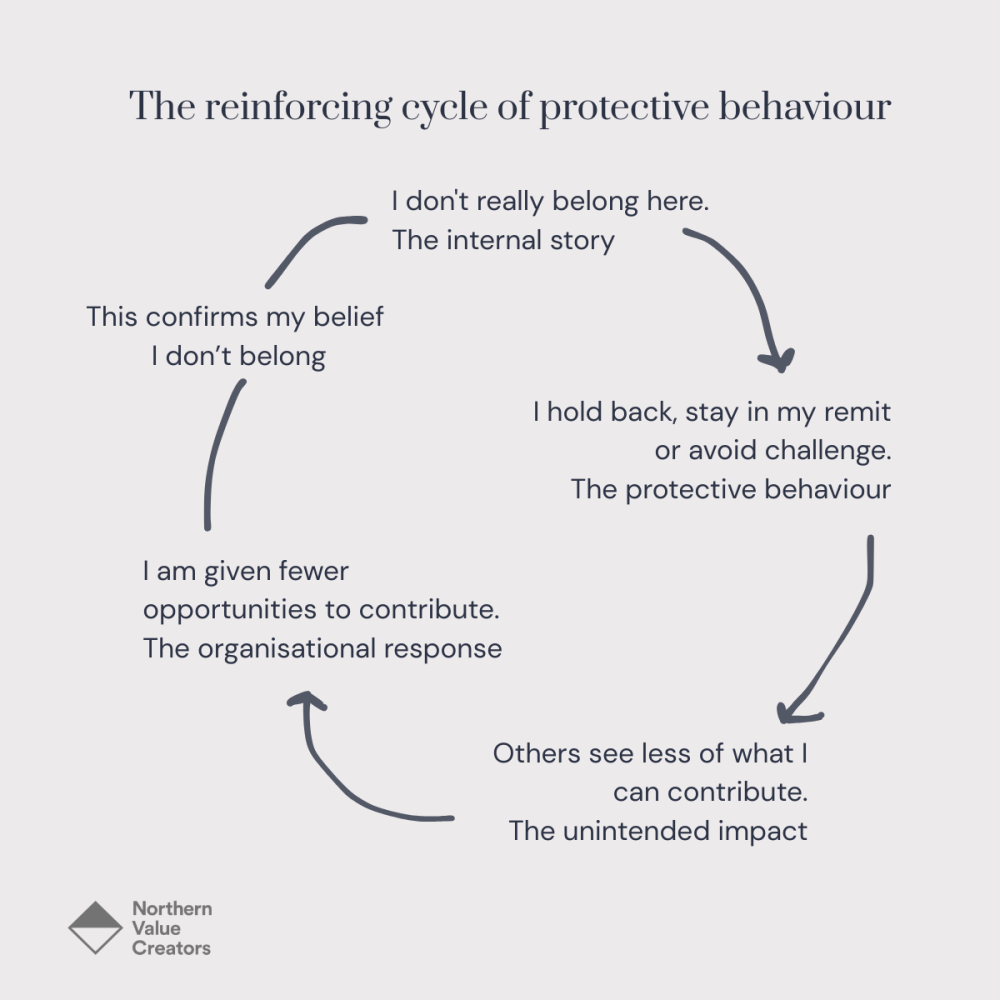
The organization sees even less of the capability that led it to appoint them.
A good appointment begins to look like a bad hire, and the fear that they never really belonged gains more evidence.
This is not simply a problem for the individual to solve.
Organizations appoint people to senior roles and sometimes assume they will automatically understand what is now expected of them. They may give someone a broader remit without helping them understand how their contribution needs to change.
My leader helped me see something I had not fully recognized in myself. He explained why I had been promoted and what he wanted me to do with my capability.
That gave me a different way of understanding my role.
But I still had to recognize what was happening inside me when I tried to occupy it.
Taking your seat
Taking your seat does not mean becoming the loudest person in the room, barging into other people's areas or pretending to have answers you do not possess.
It means recognising when fear is shaping your contribution.
If your brain is treating senior meetings, presenting, or stakeholder engagement as a threat, the first task is noticing that you have moved into protection mode.
What happens in your body? What story starts running? Which protective behaviour appears?
Do you go silent, become defensive, work harder or retreat into the safety of what you already know?
You may need to settle yourself enough to regain access to your curiosity, perspective, and fuller thinking. Only then can you decide what contribution you want to make.
You may also need to reconsider what you believe your job is.
You were not appointed to senior leadership to continue doing what made you successful before. Your organisation needs you to bring your thinking to problems that extend beyond your own area of expertise.
Self-authority is not the certainty that you are always right. It is the ability to remain present with the discomfort of not knowing and still treat your thinking as worthy of entering the conversation.
You may already have the job title, grade, and responsibility.
But if you are still waiting for permission to contribute, others may never see the leader they appointed.
And the fear that you don't belong can become the very thing that prevents you from demonstrating why you do.
Ready to transform your leadership?
Start a conversation with us about coaching, training, or toolkit resources that can help you and your team excel.